
Limestone base beneath paved surfaces
Crushed limestone can form a compacted base below asphalt, concrete, or pavers. The layer creates a more uniform platform between prepared soil and the visible surface. Its suitability depends on aggregate grading, moisture, compaction, drainage, soil, loads, and the pavement built above it.
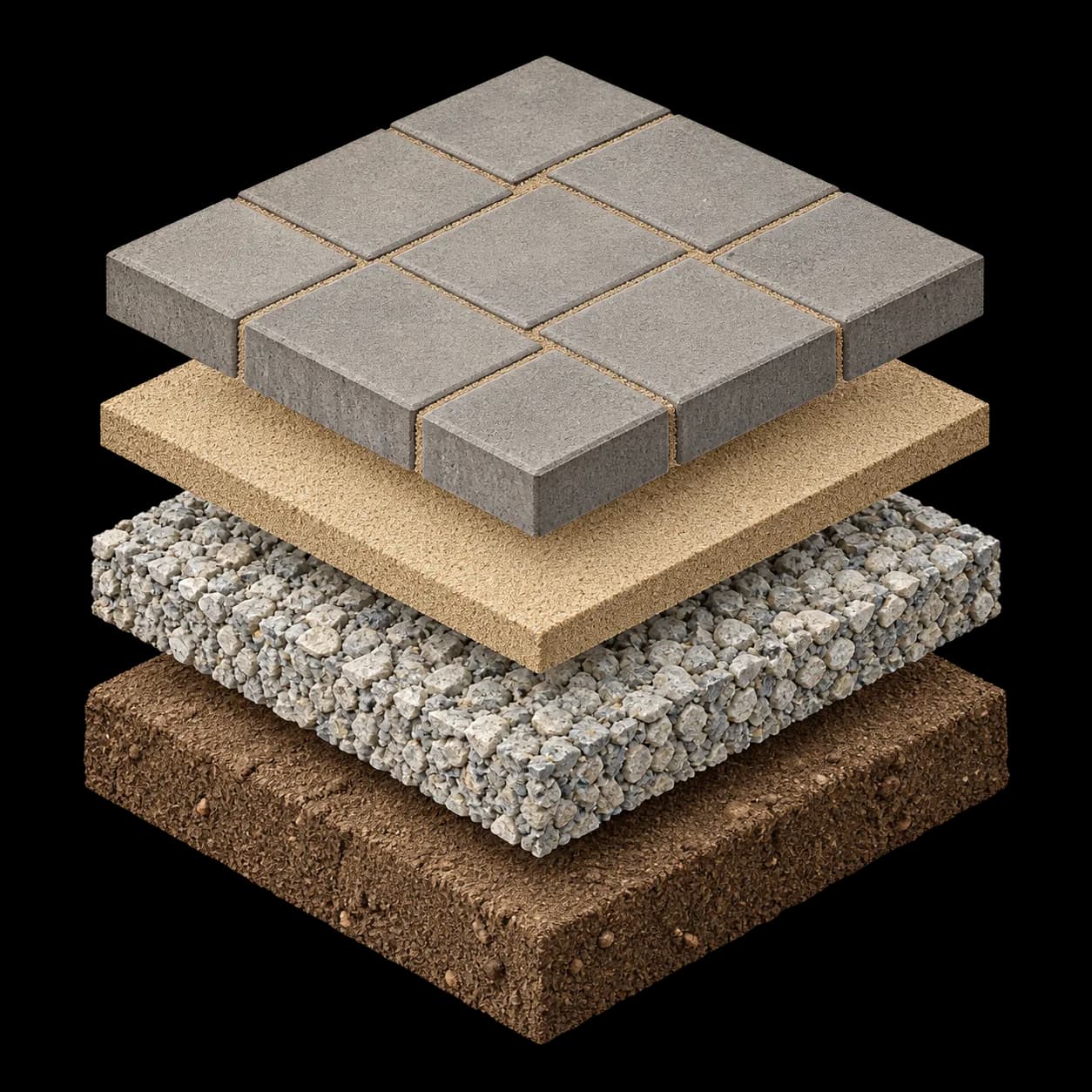
The base supports the pavement system
An aggregate base spreads loads and provides a stable working platform over the prepared subgrade. It does not act alone. Surface layers, base thickness, native soil, drainage, edges, and construction quality work as one section. A base that performs under a walkway may not suit a driveway or service area with heavier wheel loads.
The scope should identify where the base begins and ends, which existing material is removed, and what surface will be installed above it. Calling for limestone without defining the rest of the section leaves the main performance questions unanswered.
Grading matters more than the stone name
Gradation describes the range and proportion of particle sizes. A dense-graded base includes larger particles and smaller material that can be compacted into a tight layer. An open-graded aggregate intentionally leaves more connected void space for drainage. These materials serve different purposes and should not share one generic description.
The word limestone identifies the rock source, not a complete specification. Quarry product, maximum particle size, fines, cleanliness, moisture, and local standards affect placement. When those details matter to the project, the proposal should name the product or governing gradation rather than promise performance from the rock type alone.
The exposed ground can change the scope
Clay, loose fill, saturated soil, buried debris, roots, and old repairs can change preparation needs. Once removal exposes the subgrade, weak or wet areas may require undercutting, stabilization, separation, drainage, or a revised pavement detail. Adding aggregate over an unresolved soft area does not identify or remove its cause.
A clear proposal separates included preparation from work that depends on concealed conditions. It should state how the exposed ground is reviewed and how a changed scope is documented. Copying a base thickness from another property ignores differences in soil, water, traffic, and surface material.
Placement and compaction build the layer
Aggregate is commonly placed in controlled lifts so compaction equipment can work through the layer. Moisture affects how particles rearrange under compactive effort. The equipment, lift thickness, confined edges, and access all influence the result, especially in narrow side yards or small repair areas.
A compacted base also needs the planned elevations. High areas can reduce room for the surface layer; low areas can change thickness or drainage. Grade checks belong throughout placement rather than only after the visible paving is complete.
Drainage defines which base is appropriate
Water can arrive from rainfall, irrigation, roof discharge, adjacent pavement, or groundwater. The plan should show how water moves across the finished surface and whether the base is intended to drain, remain dense, or work with an outlet. FHWA distinguishes dense aggregate bases from open-graded drainage layers because their particle structures and functions differ.
A conventional compacted base is not the same as the stone reservoir in a permeable pavement. If infiltration or detention is a project goal, the entire system needs a compatible surface, open-graded layers, soil or underdrain path, overflow, and maintenance plan.
- Identify the aggregate product or gradation, not only the rock type.
- Define subgrade review, lift placement, compaction, and grade checks.
- Separate dense base, drainage layer, and permeable reservoir functions.
Common questions
Is limestone base appropriate for every driveway?
No. Suitability depends on the available aggregate, soil, water, expected loads, surface material, drainage design, and local specifications. The complete pavement section should be evaluated.
Does a thicker base always fix a soft area?
No. Softness may come from weak or wet subgrade, drainage, buried material, or another condition that needs separate correction. Thickness should follow the site and pavement design.